
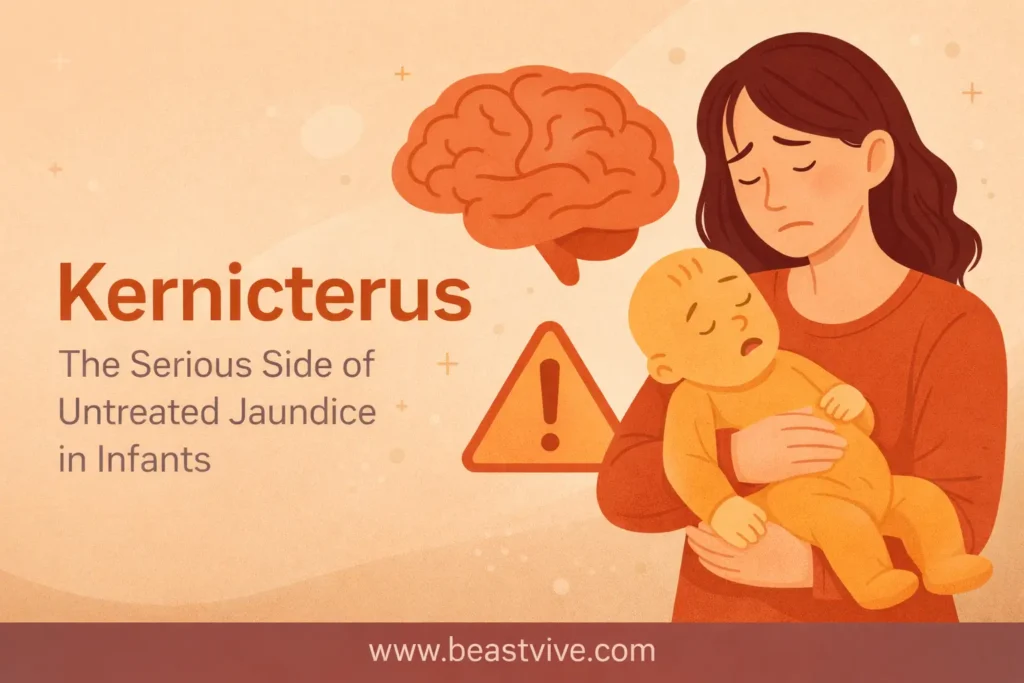
Most parents have heard of newborn jaundice — the common yellowing of a baby’s skin that usually goes away on its own.
But very few have heard of kernicterus, a rare but serious complication of untreated severe jaundice.
Before you worry, here’s the good news:
👉 Kernicterus is preventable.
👉 It almost never happens when jaundice is monitored properly.
This blog will help you understand what kernicterus is, what causes it, warning signs to watch for, and how to protect your baby — all in a calm, parent-friendly way.
Let’s start with the basics.
🟡 What Exactly Is Kernicterus?
To understand kernicterus, you first need to know about bilirubin — the pigment that causes jaundice.
Babies naturally produce bilirubin when old red blood cells break down.
In normal jaundice, the liver processes bilirubin and removes it from the body.
But if bilirubin levels become too high, it can cross into a baby’s brain tissues.
⚠️ When bilirubin builds up in the brain, it causes kernicterus, a form of brain damage.
Kernicterus is rare but serious — and almost always the result of jaundice that was not recognized or treated in time.
🌼 Why Does Kernicterus Happen?
Most newborns have some level of jaundice, but kernicterus develops only when:
- bilirubin levels rise very high
- jaundice is not monitored
- the baby isn’t feeding well
- early signs are ignored
- there is a delay in medical treatment
A healthy, full-term baby with regular check-ups is extremely unlikely to develop kernicterus.
👶 How Common Is Kernicterus?
Very, VERY rare.
Thanks to modern healthcare:
📉 Kernicterus affects less than 1 in 100,000 babies in developed countries.
It happens mainly when:
- care is delayed,
- bilirubin levels skyrocket unnoticed, or
- underlying medical conditions go untreated.
Early detection = complete prevention.
🟡 What Causes Bilirubin to Rise Too High?
While most jaundice is harmless, certain conditions make bilirubin levels climb faster.
✔ Causes include:
- Premature birth (the liver is more immature)
- Poor feeding / dehydration
- Blood type mismatch (Rh or ABO incompatibility)
- G6PD deficiency
- Birth trauma (bruising increases bilirubin)
- Infections
- Genetic conditions affecting the liver
Knowing these risk factors helps parents stay alert.
🔍 Early Signs of Dangerous Jaundice (Before Kernicterus Develops)
Parents should watch for these warning signs:
🚩 Yellow color spreading below the chest
Severe jaundice moves from face → chest → belly → legs → feet.
🚩 Very sleepy or hard to wake
A baby who doesn’t wake up for feeding needs urgent checking.
🚩 Poor feeding
Refusing to latch, sucking weakly, or fewer feeds per day.
🚩 Unusual high-pitched crying
A baby may sound irritable or cry sharply.
🚩 Arching of the body or neck
This is a late sign of worsening jaundice.
🚩 Less wet diapers
This could signal dehydration.
🚩 Dark yellow urine or pale/white stool
These are red flags for liver issues.
If any of these appear, contact a doctor immediately. Early action prevents kernicterus.
⚠️ Symptoms of Kernicterus
Kernicterus develops in stages.
Understanding these signs helps parents know when to act fast.
🟡 Early Symptoms (Immediate Action Needed)
- Extreme sleepiness
- Poor sucking & feeding
- Low muscle tone (“floppy baby”)
- Failure to stay awake to nurse
- Vomiting
- High bilirubin test results
Call your pediatrician right away if you notice these.
🔶 Intermediate Symptoms (Emergency Signs)
These signs require urgent medical attention:
- Arching the back or neck (called “retrocollis”)
- Very high-pitched crying
- Muscle stiffness
- Strange eye movements
- Fever
These symptoms indicate bilirubin is affecting the nervous system.
🔴 Advanced Symptoms (Severe Injury)
Without treatment, kernicterus may cause permanent damage:
- Hearing problems
- Vision issues
- Trouble moving limbs
- Loss of motor control
- Seizures
- Cerebral palsy-like symptoms
This is why early monitoring of jaundice is so important.
🟡 Is Kernicterus Permanent?
Sadly, yes — advanced kernicterus causes lifelong neurological damage.
But the good news remains:
👉 It is 100% preventable with early detection and treatment.
👉 It is extremely rare when proper care is given.
No parent should feel guilty — awareness saves lives, not fear.
🧪 How Doctors Check Jaundice Levels
Modern testing makes early diagnosis very easy:
✔ Skin test (transcutaneous bilirubin meter)
A quick scan — painless.
✔ Blood test (serum bilirubin)
Confirms the exact bilirubin level.
Doctors compare results to age-specific charts to determine safety.
💡 How Severe Jaundice Is Treated (Highly Effective & Safe)
If bilirubin levels are too high, treatments work quickly.
💙 1. Phototherapy (Blue Light Treatment)
The most common treatment.
- Baby lies under blue LED lights
- Breaks bilirubin into harmless particles
- Completely safe and painless
- Works within hours
Sometimes babies can go home with a portable light blanket.
🍼 2. Improved Feeding
Frequent feeding helps remove bilirubin through stool.
Doctors may recommend:
- Feeding 8–12 times/day
- Supplementation if baby is dehydrated
- Lactation support
💉 3. Exchange Transfusion (Rare)
Used only in extreme cases.
Doctors replace baby’s blood gradually to remove bilirubin quickly.
This procedure is safe but rarely required.
🌼 How Parents Can Help Prevent Kernicterus
Most cases are prevented by early monitoring and feeding support.
✔ 1. Feed frequently
Helps bilirubin leave the body naturally.
✔ 2. Watch your baby’s skin tone daily
Check eyes, chest, and legs in natural light.
✔ 3. Know risk factors
If your baby is premature, bruised from birth, or blood type incompatible, stay extra alert.
✔ 4. Attend newborn check-ups
Don’t skip the first-week appointments — bilirubin peaks around day 3–5.
✔ 5. Call your doctor if something feels “off”
You know your baby best.
🧡 Emotional Support for Parents
Hearing words like “jaundice,” “bilirubin,” or “brain damage” can be terrifying.
But remember:
💛 Most jaundice is harmless
💛 Kernicterus is extremely rare
💛 Simple treatments work fast
💛 Your baby is much safer today thanks to monitoring
💛 Asking questions makes you a great parent
You’re doing the right thing by learning and staying aware.
🌟 Frequently Asked Questions (Parent-Friendly)
✔ Can breastfeeding cause kernicterus?
No. Breastfeeding may cause mild jaundice but not kernicterus by itself.
✔ Can sunlight treat jaundice?
No. Direct sunlight is dangerous for newborns. Only medical phototherapy works.
✔ How long does newborn jaundice last?
Usually 1–2 weeks. Breast milk jaundice can last longer but is usually harmless.
✔ Can kernicterus be cured?
Damage from kernicterus is permanent, but early detection prevents it completely.
Awareness Protects Your Baby
Kernicterus is frightening to hear about, but remember:
👉 It’s very rare.
👉 It’s completely preventable.
👉 Jaundice is normal — severe jaundice isn’t.
👉 Monitoring your baby is the best protection.If you follow check-ups, watch for warning signs, and seek help when needed, your baby will have a safe and healthy start.
You’re doing an incredible job — and learning all this shows how deeply you care. 💛
